· Early access

Get early access
Copilot Kit Logo

Building Fullstack Agentic Apps with Realtime Data: CopilotKit + Tavily

By Nathan Tarbert
September 18, 2025
Building Fullstack Agentic Apps with Realtime Data: CopilotKit + Tavily

Tavily: Real-Time Web Access Layer for Agents

Today, we are announcing the CopilotKit+Tavily partnership. Let's dive into why this makes so much sense.

Tavily powers the Internet of agents with fast, secure, and reliable web access APIs, reducing hallucinations and making agents more powerful.

Tavily gives your assistant the ability to:
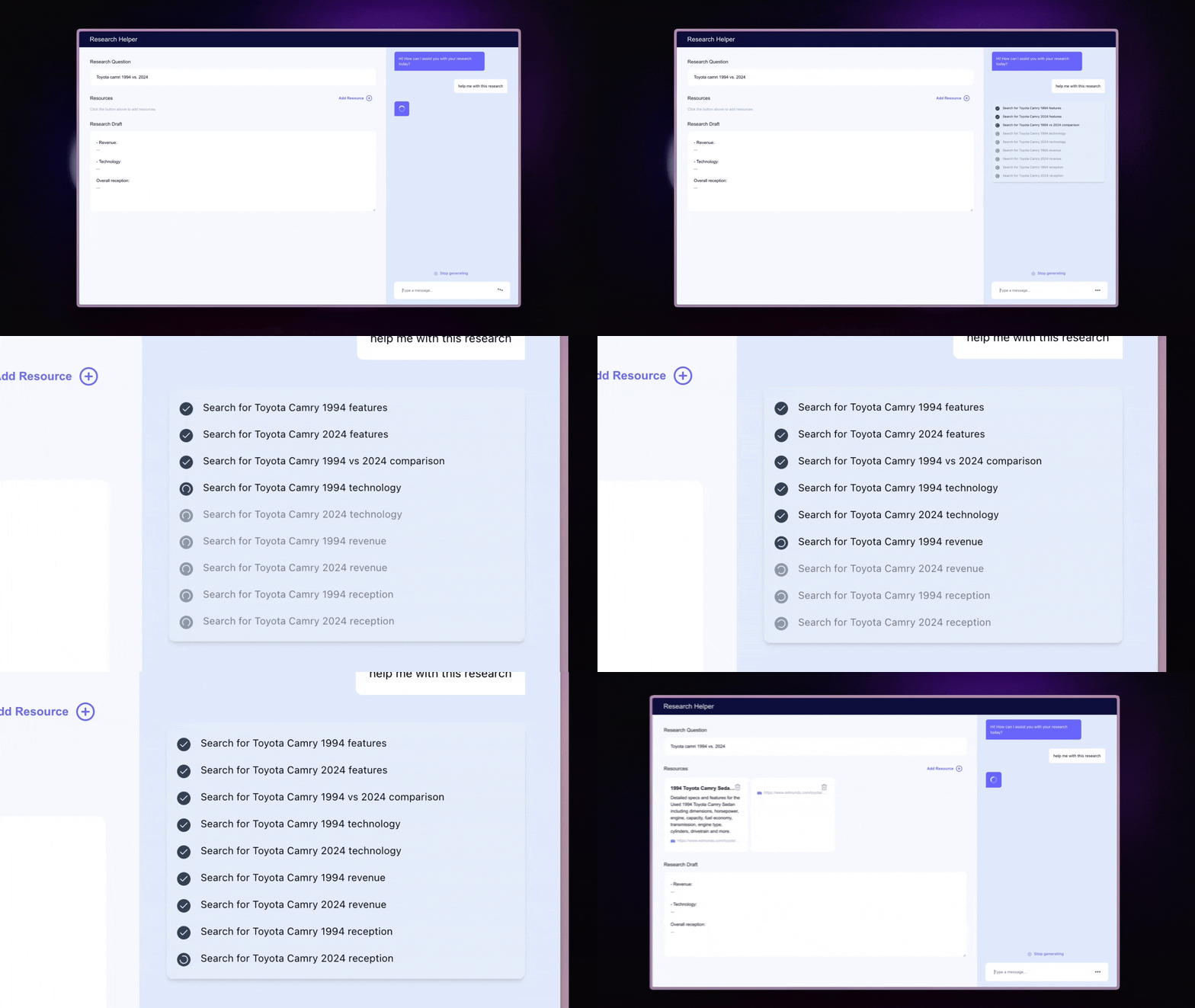
  • Search the live web: Fetch current, relevant information-i.e., news, regulations, product updates
  • Crawl and extract content: Go deeper than snippets and pull structured data from full pages
  • Provide sources and citations: Every answer comes with provenance, so users can verify
  • Keep data private: Zero data retention, optional PII redaction, and prompt-injection guardrails
Demo GIF

You get all this through an API with SDKs for Python and JavaScript, and integrated into some agent frameworks such as LangChain and LlamaIndex. No need to reinvent search or scraping infrastructure.

CopilotKit: Making Agents Interactive

CopilotKit solves the other half of the equation: bringing the empowered agent to the user.

Why, because agents aren’t just backend workers anymore. To feel useful, they need to be part of the UI itself.

This is the role of CopilotKit. It lets you embed agent intelligence directly into your React components, so your app isn’t just a “chat with an LLM”. It’s agentic and collaborative which brings features such as:

  • UI integration via AG-UI: Assistants don't just chat, they turn your frontend interactive
  • Fullstack context: Copilots can see app state, backend data, tools, and user actions
  • Human-in-the-loop: Developers define how AI suggestions appear and when users approve workflows

Let’s look at a typical pattern:

  • User asks: “Show me today’s top tech news.”
  • Agent calls —> Tavily.
  • Results are streamed into a UI component, showing each article inline.
  • User clicks one —> agent expands it, summarizes, or fetches related papers.

Instead of copy-pasting from a chatbox, the agent is driving real interactivity in the app.

Together, Tavily and CopilotKit transform a basic LLM into a context-aware assistant that can fetch current information and act on it within your application.

Play with a live app using CopilotKit, LangGraph, and Tavily here.

Real-Time + Agentic UI = Interactive UI

This is what is unique. By combining real time data (Tavily) and Agentic UI (CopilotKit), you close the feedback loop:

  • A CopilotKit app can call Tavily for live data and present it directly in the UI.
  • Agentic UI patterns to follow:
    • Inline updates: agent retrieves data via Tavily and populates UI components dynamically.
    • Multi-step flows: User asks a question → Agent calls Tavily → UI updates live → User interacts → Agent continues the loop
  • This creates a closed loop between User <> Agent, and the live data.

Why This Is Agentic

  • Real time retrieval prevents hallucinations
  • CopilotKit provides interactivity (Headless or Chat)
  • Together, they enable agentic experiences where the user and agent collaborate live on fresh data.

Get Started

Turn your app into more than a demo. Build a copilot that belongs in production.
Top posts

See All
Switching to Fable 5: The Tuesday That Cost $22,000
Jordan Ritter June 12, 2026
Switching to Fable 5: The Tuesday That Cost $22,000CopilotKit swapped their coding agents to a new model (fable-5) on a Tuesday, and by Wednesday had run up a ~$22,000 Anthropic bill. No bug or runaway script caused it — five engineers doing normal work triggered it, because the new model interpreted their English-prose behavioral rules ("keep sub-agents small," "converge to zero") far more loosely than older models did. The result was four simultaneous drift modes: bloated sub-agents, runaway review loops, exploding fanout, and oversized single turns. What kept it from being far worse was their "skills" system — small, named instruction packs that agents auto-load to encode team conventions. Their instrumentation caught the runaway in 12 hours instead of 12 days, isolated worktrees contained the blast radius, and the fix lived at the rules layer (swapping vague adjectives for hard numeric budgets and machine-checkable gates) rather than in application code. The takeaway: if you let AI agents do real work, you need a guardrails layer that encodes desired behavior separately from the agents — small, composable, and faster to change than a model. Because models will change, and the team with a rules layer pays $22K and writes a blog post; the team without one pays more and writes a press release.
Build AI Agents That Live Inside Your App — CopilotKit Explained
Nathan Tarbert June 12, 2026
Build AI Agents That Live Inside Your App — CopilotKit ExplainedCopilotKit is a complete set of building blocks for developers and teams who want to add agents to their app and assemble, debug, and ship the interface layer between their agents and users. It's also framework-agnostic and supports any LLM and every popular agent framework. There are two options for chat. Pre-built components, if you want something already built or Headless UI, which allows anyone to build custom agent interfaces.
CopilotKit - The Complete Frontend Stack for AI Agents
Anmol Baranwal and Nathan TarbertMay 20, 2026
CopilotKit - The Complete Frontend Stack for AI AgentsCopilotkit is the open source frontend stack for AI agents. Learn about architecture, chat components, hooks, generative UI, persistent memory, debugging tools, and 13+ agent framework integrations for building Agentic UIs.
Are you ready?

Stay in the know

Subscribe to our blog and get updates on CopilotKit in your inbox.