· Early access

Get early access
Copilot Kit Logo

August’s Feature Rollout: Enhanced CopilotKit Capabilities Await! 😎

By Atai Barkai
August 26, 2024
August’s Feature Rollout: Enhanced CopilotKit Capabilities Await! 😎

August CopilotKit releases: debugging, async ops for RAG, Groq adapter

Last month’s releases helped developers ship copilots with better experiences all around. From the new CopilotKit runtime to the new generative UI to critical guardrail features in Copilot Cloud.

This month the team shipped new tools like native debugging in the console plus runtime improvements including new features contributed by the community. And don’t miss the latest tutorials and improved UX in the refreshed documentation.

Local debugging tools in the CopilotKit dev console

Helping developers to move fast to test and ship copilot apps Is our objective. The new debugging tools in the dev console enable quick troubleshooting across three critical areas in your app - Readables, Actions, and Check Updates.
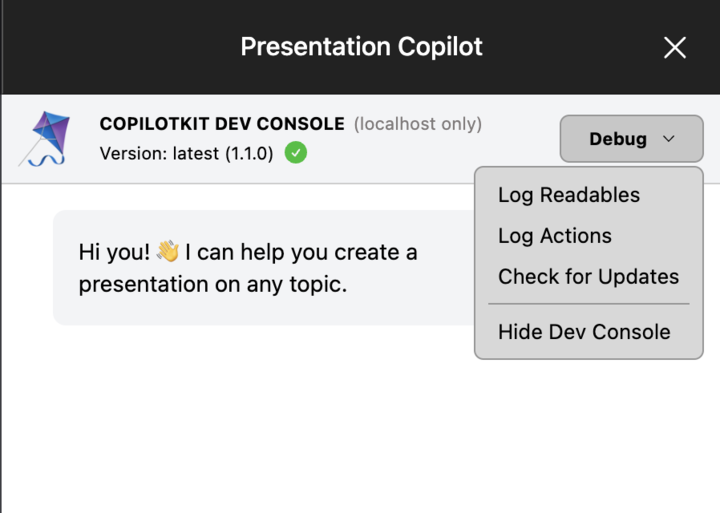
  • Log Readables - see which real-time state your app is making available to the Copilot
  • Log Actions - log the current actions your app is registering with the Copilot
  • Check Updates - find out if there are major library updates you should be aware of.
__wf_reserved_inherit

The dev console is enabled by default when running on localhost- and can also be shown or hidden manually. It is displayed at the top-right corner of the Chat UI.

Runtime enhancements with Groq adapter and constructor parameters middleware

Continuing to build on runtime improvements from last month, our adapter library now includes Groq support in addition to Google GenAI, LangChain, and OpenAI.  These service adapters make it easy to leverage the power of AI and LLM platforms in your copilot app with a standardized request and response format.

The runtime also got a significant update with middleware to enable developers to further customize their copilot app in novel ways. Our design philosophy for CopilotKit is ‘batteries included, and replaceable’. We aim to make CopilotKit buttery-smooth for common Copilot use cases; and also to make it adaptable to edge cases we haven’t specifically designed for.

The new middleware lets you pass your code to the Copilot Runtime - to be run in between critical framework-owned steps.

This deployment led to the next exciting feature below, made available by a contribution from the community!

New async operations available for RAG integration

While the CopilotKit messaging handling allowed for synchronized operations, this limited the ability in certain use cases such as when you need to log into databases for retrieval-augmented generation.

Thanks to Steve V S’  contributions, CopilotKit middleware now supports async functions, as well as optimized appending logic, and improved error handling. This is available in the self-hosted version of CopilotKit.

CopilotKit community contributions - thank you!

Speaking of contributors, the contribution guide is updated to make it easier for the community to submit issues, features, and documentation. It’s this community that helps make CopilotKit better for everyone.

Every Thursday join the CopilotKit team in our Discord office hours to catch up on the latest releases, and contributions, and for extra support on the Copilot apps you’re building.
Top posts

See All
The Tuesday That Cost $22,000
Jordan Ritter June 12, 2026
The Tuesday That Cost $22,000CopilotKit swapped their coding agents to a new model (fable-5) on a Tuesday, and by Wednesday had run up a ~$22,000 Anthropic bill. No bug or runaway script caused it — five engineers doing normal work triggered it, because the new model interpreted their English-prose behavioral rules ("keep sub-agents small," "converge to zero") far more loosely than older models did. The result was four simultaneous drift modes: bloated sub-agents, runaway review loops, exploding fanout, and oversized single turns. What kept it from being far worse was their "skills" system — small, named instruction packs that agents auto-load to encode team conventions. Their instrumentation caught the runaway in 12 hours instead of 12 days, isolated worktrees contained the blast radius, and the fix lived at the rules layer (swapping vague adjectives for hard numeric budgets and machine-checkable gates) rather than in application code. The takeaway: if you let AI agents do real work, you need a guardrails layer that encodes desired behavior separately from the agents — small, composable, and faster to change than a model. Because models will change, and the team with a rules layer pays $22K and writes a blog post; the team without one pays more and writes a press release.
Build AI Agents That Live Inside Your App — CopilotKit Explained
Nathan Tarbert June 12, 2026
Build AI Agents That Live Inside Your App — CopilotKit ExplainedCopilotKit is a complete set of building blocks for developers and teams who want to add agents to their app and assemble, debug, and ship the interface layer between their agents and users. It's also framework-agnostic and supports any LLM and every popular agent framework. There are two options for chat. Pre-built components, if you want something already built or Headless UI, which allows anyone to build custom agent interfaces.
CopilotKit - The Complete Frontend Stack for AI Agents
Anmol Baranwal and Nathan TarbertMay 20, 2026
CopilotKit - The Complete Frontend Stack for AI AgentsCopilotkit is the open source frontend stack for AI agents. Learn about architecture, chat components, hooks, generative UI, persistent memory, debugging tools, and 13+ agent framework integrations for building Agentic UIs.
Are you ready?

Stay in the know

Subscribe to our blog and get updates on CopilotKit in your inbox.