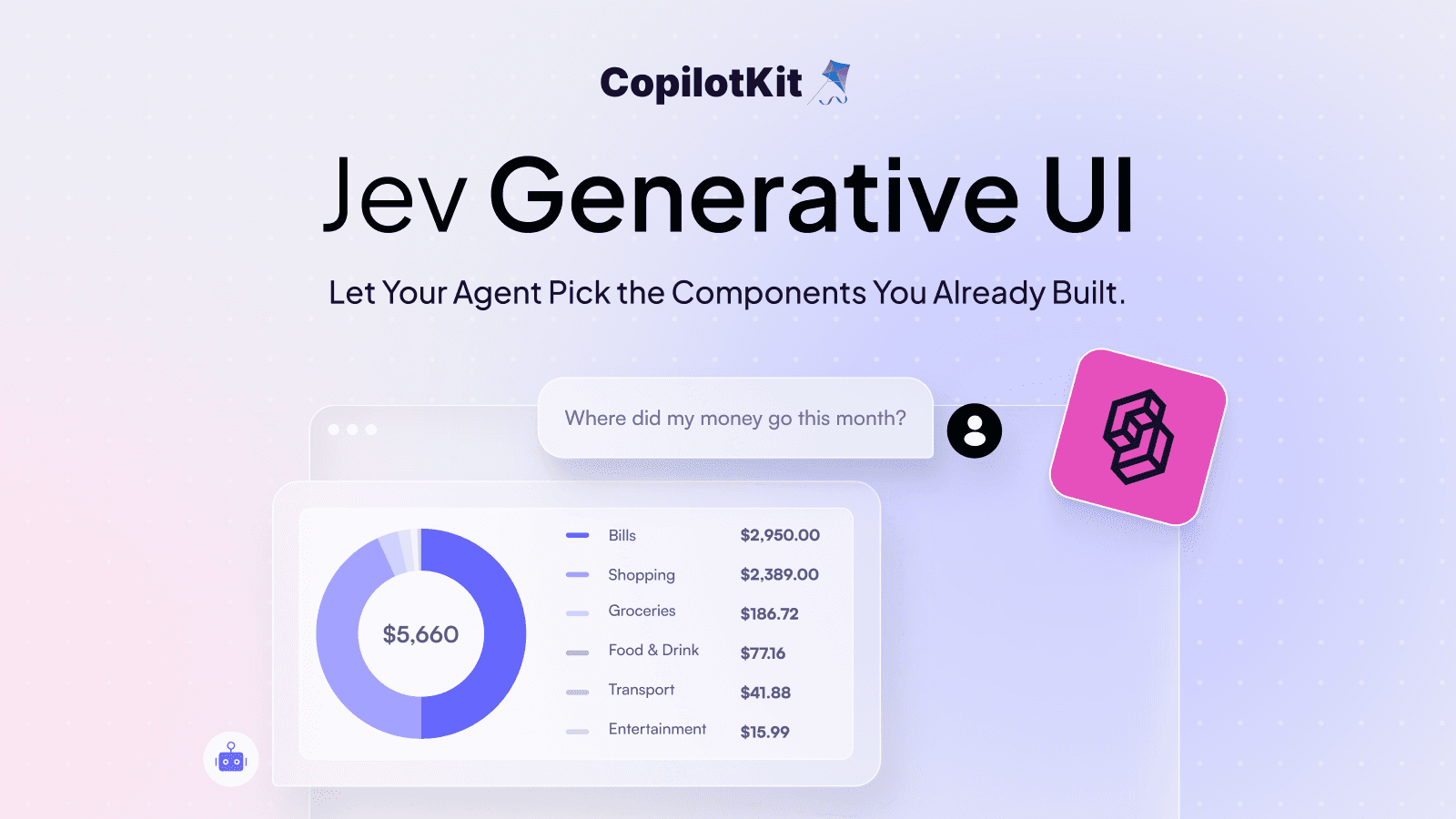
I have worked on CopilotKit for about two years, and the question I hear most from engineers at large companies is the same one: "Our agent works. How do we get it to show something better than text?"
The usual answer is to have a language model write the interface. If you have tried it, you know the result: markup that drifts from your design system, buttons close to yours but not yours, and tokens and seconds spent on every screen.
There is a better split of the work. Your team already owns a reviewed, accessible component catalog. What the agent lacks is the judgment to choose from it. Here is how Jev, TypeSafe's decision model, fits generative UI: what it does, how we wire it into CopilotKit, and what it looks like in products you would recognize.
Jev is the first "System One" model from TypeSafe. It does not generate text. You give it state and a question, and it returns typed answers with probabilities.
There are three primitives. Choice picks one option from a set. Noul returns the probability that a condition holds. Score places something on an ordered scale. Independent questions over the same state run in parallel.
Layout questions fit that shape: "Which container fits this request? Does the user need a chart? How dense should the table be?" Each is a Choice, a Noul or a Score.
We call the pattern a Generative UI Decision Engine, or GDE. It has four steps.
An engineer at a top-10 US insurer is adding an agent to the claims portal. A policyholder types: "I hit a deer last night and the hood is crushed."
Jev reads the conversation state and the catalog. It picks a claim-intake stepper, a photo-upload tile, a policy-coverage summary card and a "talk to an adjuster" action.
The product gains an intake flow built only from approved components, so the user never has to hunt for the right screen.
An engineer at a regional bank builds an agent into the treasury dashboard. A cash manager asks: "Why did our operating account dip on Tuesday?"
Jev picks a time-series chart, a transaction table filtered to that account and date, and a variance callout. A Noul question, is this a data problem or a real movement, decides whether a "report an issue" control appears.
The product gains answers shown in components the bank's risk team has already reviewed.
At a large employer, an engineer adds an agent to the IT and HR service portal. An employee writes: "My laptop won't connect to the VPN and I start a new project Monday."
Jev picks a troubleshooting checklist, a ticket form pre-scoped to network access, and a card showing the next-day laptop swap option. The product gains tickets that start in the right form.
If you came here looking to build an AI classifier or to classify user intent, this is the same problem in a new setting. Each request is classified into components from your catalog. Jev's Choice primitive picks one option from a defined set and returns a probability for each option.
That changes what you can do in code. Set a confidence threshold and fall back to a default view when it is not met. Log the probabilities and show a product manager why a user saw tabs and not an accordion. TypeSafe's cookbooks cover classification, including hierarchical classification. I am not claiming Jev beats other classifiers on accuracy. I am saying the output is typed and carries probabilities you can act on. In my own testing, about 470 Jev decisions cost six cents.
Pick one screen where your agent answers in text and the user then goes looking for the right page. Register the five or six components that screen uses with CopilotKit. Write the questions Jev needs to answer to choose among them. Then get started with CopilotKit and read how generative UI in CopilotKit works.
What is Jev, and is it an LLM?
No. Jev does not generate text. It takes state plus a question and returns typed answers with probabilities, through Choice, Noul and Score. That is why Jev generative UI works as a layout decision and not a writing task.
Can I use Jev to classify user intent?
Yes. Choice picks one option from a set you define and returns a probability for each, so you can threshold, fall back and log. See TypeSafe's classification cookbooks for patterns.
Can an AI agent use my existing design system for generative UI?
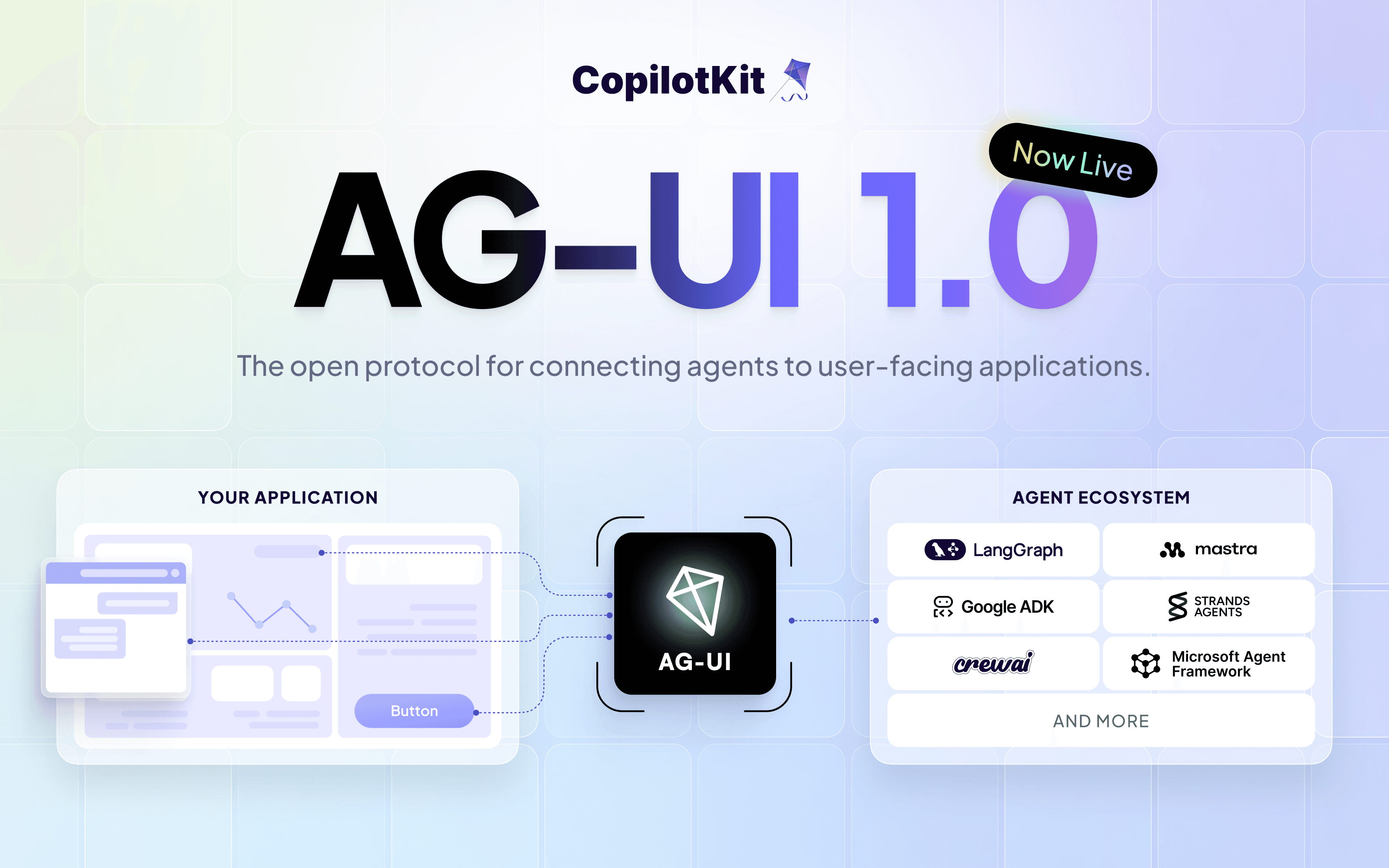
Yes. You declare components in your frontend, the catalog travels to the agent over AG-UI, and Jev chooses among components you already have.
If your engineering team is building agents that work with humans, book 30 minutes with our lead engineers to see how you can use CopilotKit to stand up a working agent in your product in two weeks.

Subscribe to our blog and get updates on CopilotKit in your inbox.