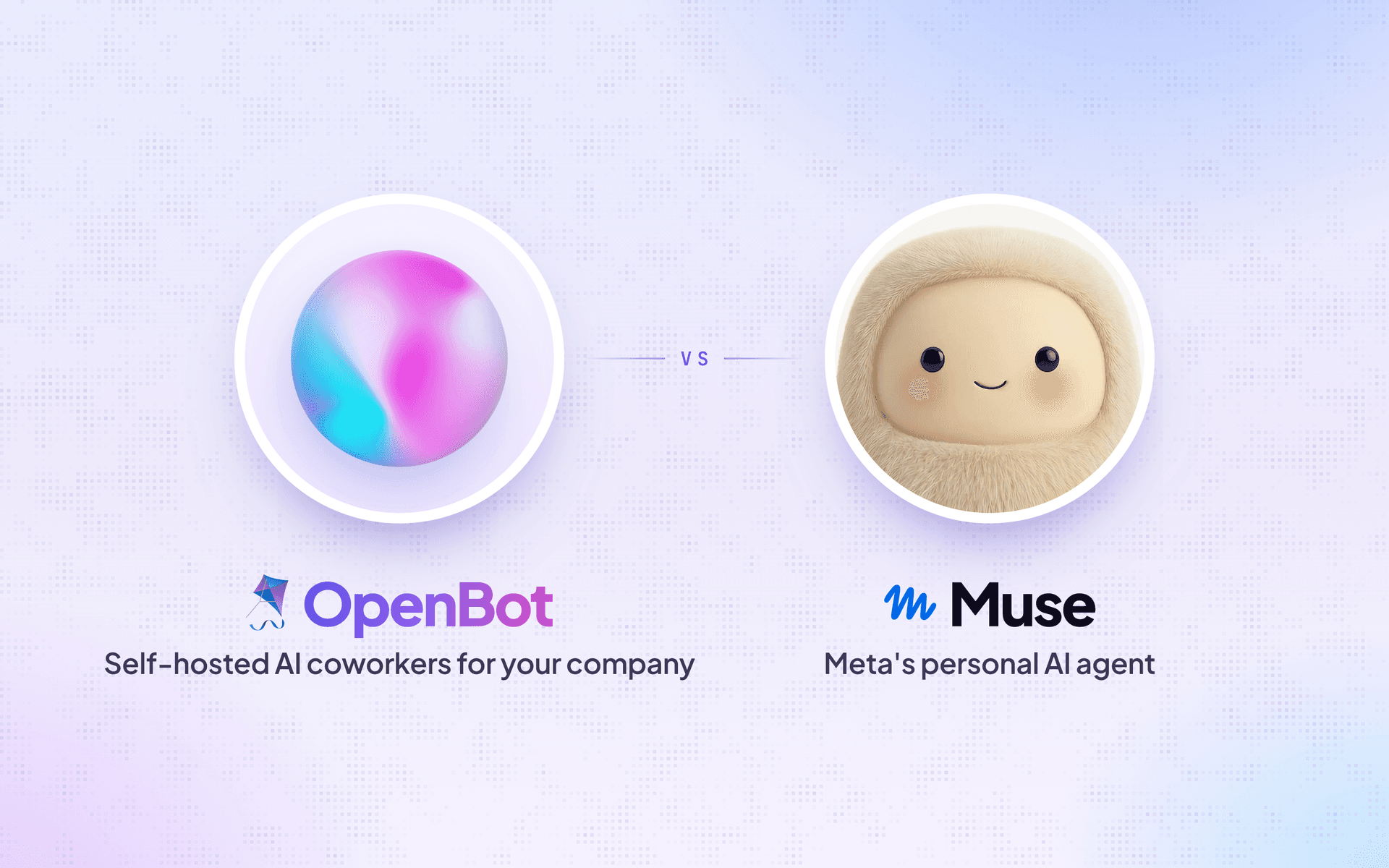
OpenBot vs Meta Muse: Self-Hosted AI Coworkers for Your Business

By Anmol Baranwal
October 23, 2026
OpenBot vs Meta Muse: Self-Hosted AI Coworkers for Your Business

Meta's Muse is a personal AI agent you use from your phone or the web. It works on its own cloud computer with a browser, finishes tasks for you and checks with you before sensitive actions, like sending an email or making a purchase.

OpenBot gives your company self-hosted AI coworkers that run on your own servers and connect to the tools you already use. It's fully customizable, works with any agent harness and any model, and keeps learning from how your teams work. With OpenBot for Business, our engineers set it up under your brand, with company sign-in, central controls, dedicated support and more.

For a business, the difference comes down to who the AI coworkers are built for, where they run, who can reach your data, and whether you can bring your own agents and models.

What is Meta Muse

Muse is Meta's personal AI agent, available on iOS, Android and the web in the US and Canada. It runs on Muse Secure VM, a cloud computer with its own browser that Meta operates, and it's powered by Meta's Muse Spark model. A separate Sentinel agent approves anything Muse sends to the internet.

With Muse for Small Business, owners give Muse a goal and connect it to tools like Instagram, Shopify, Stripe, QuickBooks and Slack, all inside the same app. Each user gets their own Muse and VM.

What is OpenBot for Business

Over the past few months, we open-sourced our own versions of the big AI coworker products, including OpenMuse for Meta Muse. OpenBot for Business turns that core into one business-ready product for companies that want AI coworkers on their own terms.

Your teams share AI coworkers that use your apps, finish real work and get better the more they're used. Each coworker can get its own computer and follows the rules your IT team writes. Coworkers show up in the OpenBot app on web, desktop and mobile, and in Slack and Microsoft Teams.

Our forward deployed engineers:
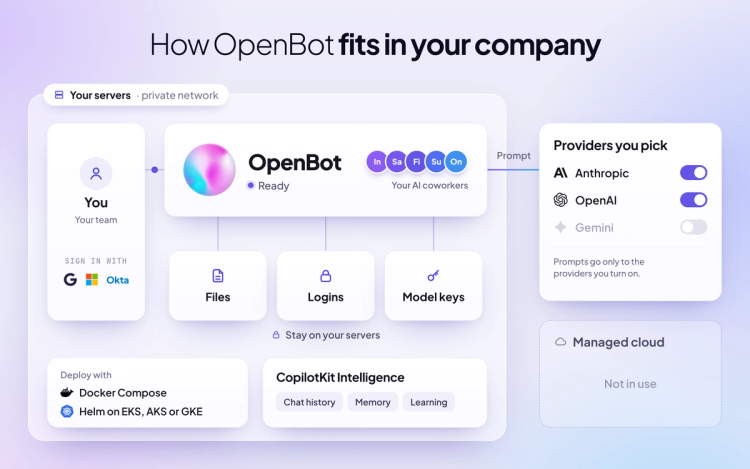
  • Deploy OpenBot on your servers, from a single machine to Kubernetes on EKS, AKS or GKE
  • Make it look like your own product, with your branding and your coworkers
  • Build your first AI coworker with you and provide dedicated support as your team grows
__wf_reserved_inherit

Meta Muse vs OpenBot at a glance

Both give you AI coworkers with a computer of their own that finish work and ask before sensitive actions. The differences show up in who they're built for, where they run and how much of the stack you control.

  1. Who it's for
    • Muse: one person, on iOS, Android or the web. Small business owners get extra skills and connectors in the same app
    • OpenBot: AI coworkers belong to the company, so a whole team can share one on web, desktop, mobile, Slack or Microsoft Teams
  2. Where it runs
    • Muse: on Muse Secure VM, a cloud computer Meta operates, one per user, with backups Meta maintains. Available in the US and Canada
    • OpenBot: on your own servers, from one machine with Docker to Kubernetes with Helm, wherever you deploy it
  3. Who can reach your data
    • Muse: each user's VM is isolated from other users' agents. Meta says its setup "does not prevent Meta from accessing data when necessary to support, secure or operate the service", and it's testing a Confidential VM where only the user holds the encryption key. In October, Meta paused Muse's conversation-sharing links while it reviewed a security report about them
    • OpenBot: files and stored credentials stay on your servers, and you choose which model providers see your prompts
  4. Agents and models
    • Muse: runs on Meta's own agent and the Muse Spark model
    • OpenBot: any agent that speaks AG-UI (Agent-User Interaction Protocol) joins as a coworker, on OpenAI, Anthropic, Google or local models through any OpenAI-compatible server
  5. Training
    • Muse: the training setting is on when you first use Muse, and each user can switch it off
    • OpenBot: no model is bundled, so the providers you pick set the training terms
  6. What it learns
    • Muse: learns from what you share. Each user can delete, ask Muse to forget a topic or reset it, though Muse may still remember what it learned from deleted items
    • OpenBot: every approved skill is a plain SKILL.md file you can download with the CLI
  7. Apps and tools
    • Muse: Instagram, Facebook Pages, Meta ads, Shopify, Stripe, QuickBooks, Slack, Notion and more, plus custom connectors. Muse also shops the web for you, and Amazon has blocked it from Amazon.com, saying it breaks Amazon's terms of use
    • OpenBot: Google Drive, Notion, a few hundred apps through Composio and any MCP server your admins approve. Each coworker's computer keeps its own logins for your company's apps
  8. Approvals
    • Muse: checks with you before sensitive actions, and the Sentinel agent approves anything that reaches the internet
    • OpenBot: every action is checked against your IT team's rules before it runs, sensitive actions wait for a person, and every decision is recorded
  9. Sign-in and audit
    • Muse: each user manages their own settings, data downloads and deletes
    • OpenBot: Google, Microsoft, Okta, SAML and OIDC sign-in, SCIM 2.0, and an audit trail that streams to your SIEM over OpenTelemetry
  10. Brand and setup
    • Muse: Meta's product, with its own branding
    • OpenBot: set up by our engineers to look like your own product

OpenBot's AI coworkers learn from your teams

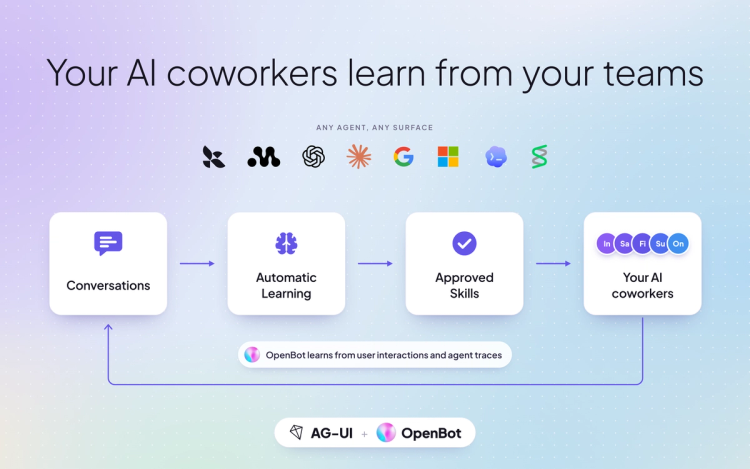
Muse learns from what each person shares, and each user decides what it forgets. In OpenBot, everything a coworker learns is visible and reviewable, and your company decides what sticks. All of it runs on CopilotKit Intelligence, which you can self-host or use in our cloud.

With User Memories, each coworker keeps your people's preferences and project context across conversations, for one user or shared across a project. Your team can list, update or remove any memory.

With the OpenBot Recorder, your team can show a coworker a task once in the browser, and OpenBot learns and repeats it. Admins manage learning centrally, and each coworker learns in its own container.

With Automatic Learning, OpenBot also reads your coworkers' finished threads, finds the patterns and proposes each insight as a skill. Every skill is a SKILL.md your team reviews, and it reaches your coworkers only after a person approves it.
__wf_reserved_inherit

Meta Muse or OpenBot: which fits your company

Muse fits individuals and small business owners in the US and Canada who want a capable personal agent of their own.

OpenBot fits companies that:

  • Need AI coworkers whole teams can share
  • Want everything running on their own infrastructure
  • Need company sign-in and a record of every action

OpenBot vs Meta Muse FAQ

1. What's the difference between OpenBot and Meta Muse?

Meta's Muse is a personal AI agent that runs on a cloud computer Meta operates, one per user. OpenBot gives teams shared AI coworkers on your own servers, works with any agent and model, and is set up by our engineers under your brand.

2. Can OpenBot be self-hosted?

Yes. OpenBot runs on a single machine with Docker, or on Kubernetes with Helm on EKS, AKS, GKE or your own cluster. Muse runs on Muse Secure VM, a cloud computer Meta operates.

3. Is there an open source version of Meta Muse?

Yes. OpenMuse is CopilotKit's open-source version of Meta Muse, a template developers build on. OpenBot for Business is the version companies run, with setup on your servers, your branding and support from our engineers.

4. Does OpenBot have SSO and an admin console?

Yes. OpenBot includes Google, Microsoft, Okta, SAML and OIDC sign-in, SCIM 2.0, central admin and an audit trail that streams to your SIEM. In Muse, each user manages their own settings.

5. Who can access data in OpenBot?

Your company. OpenBot runs on your servers, files and stored credentials stay there, and you choose which model providers see your prompts. For Muse, Meta says its setup "does not prevent Meta from accessing data when necessary to support, secure or operate the service."

6. How do I get OpenBot?

OpenBot is free and open source on GitHub. OpenBot for Business is in early access. Book a demo at openbot.co/enterprise and our engineers will build your first AI coworker with you.

Get started

OpenBot brings self-hosted AI coworkers to every team, on your servers and under your rules. To see everything it can do, refer to the OpenBot for Business page.

To learn more:

Read more of our comparison blogs on OpenBot and other AI coworker products:

If you want to see OpenBot for Business in action, we suggest booking a demo. Our engineering team will build your first AI coworker with you and provide dedicated support as your team grows.

Stop renting your AI. Own it.

Follow CopilotKit on Twitter for updates. If you get stuck, reach out in the CopilotKit or AG-UI communities.
Top posts

See All
Ship Google Antigravity agents to your users with AG-UI, CopilotKit and OpenBot
Anmol Baranwal and Eli BermanNovember 3, 2026
Ship Google Antigravity agents to your users with AG-UI, CopilotKit and OpenBotGoogle Antigravity agents can now ship to your users. Antigravity is AG-UI compatible, with full docs and a live Dojo in CopilotKit, and OpenBot, our open-source AI coworker app, now runs coworkers on Antigravity. The Antigravity cookbook ties it all together in Repo Doctor, a full agentic app that fixes broken CI and proves the fix, with CopilotKit Intelligence, Google Cloud deployment and the complete source on GitHub. All open source.
Google Antigravity is now AG-UI Compatible
Anmol Baranwal and Eli BermanNovember 3, 2026
Google Antigravity is now AG-UI CompatibleGoogle Antigravity is now AG-UI compatible, so any Antigravity agent can run inside your app with CopilotKit. Antigravity is Google’s agent SDK, giving your code the same agent harness powering Google’s products. The ag-ui-antigravity integration streams every step the agent takes to your frontend, with generative UI including A2UI, human-in-the-loop approvals, shared state, frontend tools, attachments, and live rendering for Antigravity’s built-in file and shell tools. Try every feature in the Dojo or inside OpenBot.
How to build a Google Antigravity Agent That Fixes Failing CI with CopilotKit
Anmol Baranwal November 3, 2026
How to build a Google Antigravity Agent That Fixes Failing CI with CopilotKitGoogle Antigravity brings Google’s own agent harness to your code, with built-in tools to read files, run commands and edit code. In this tutorial, we use the new Antigravity AG-UI SDK and CopilotKit to build a debugging agent that finds why CI is failing, fixes it and proves the fix. The agent gets its own CI tools, approvals you can switch to auto-approve, and test results rendered as generative UI with A2UI. Every conversation is saved in CopilotKit Intelligence, and the whole app deploys to Google Cloud.
Are you ready?

Stay in the know

Subscribe to our blog and get updates on CopilotKit in your inbox.