Grok Bot from xAI gives each person a team of always-on AI coworkers. Each Bot works on a persistent cloud computer, signs in to your tools and keeps going in the background until the job is done.
OpenBot gives your company self-hosted AI coworkers that run on your own servers. Your teams reach them in Slack, Microsoft Teams and the OpenBot app, and they connect to the tools you already use.
OpenBot is fully customizable and works with any agent harness and any model. It keeps learning from how your teams work, and with OpenBot for Business, our engineers set it up under your brand, with company sign-in, central controls, dedicated support and more.
For a business, the choice comes down to three things: who owns the AI coworkers and the data behind them, how far you can customize them, and whether your own agents and models can power them.
Grok Bot is an agentic product from xAI. Each Bot works on a persistent cloud computer, uses the apps a member signs it into, and asks for approval before sensitive actions. Teams can share one Bot in Slack, and members reach their Bots from desktop, iOS and Android.
Where it runs is the main limit for many companies. Grok Bot runs only on Cursor-hosted cloud computers, which run in the United States today, and on-premises deployment is "not supported today". All of a member's Bots share one computer, and Cursor manages which models they use.
Over the past few months, we open-sourced our own versions of the big AI coworker products, including OpenBot for Grok Bot. OpenBot for Business turns that core into one business-ready product for companies that want AI coworkers on their own terms.
Your teams share AI coworkers that use your apps, finish real work and get better the more they're used. Each coworker can get its own computer and follows the rules your IT team writes.
Our forward deployed engineers:
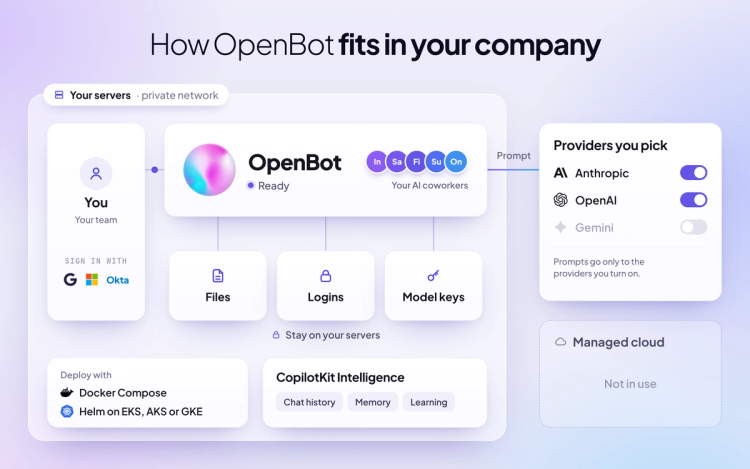
Both give your team AI coworkers that sign in to your tools and finish work on their own. The differences show up in where they run, who controls them and how much of the stack you can change.
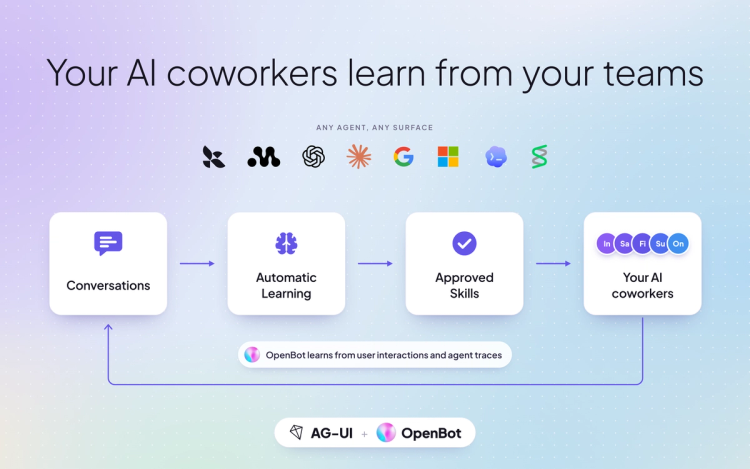
SKILL.md file you can download with the CLIOpenBot’s AI coworkers keep getting better from the work your teams already do.
With the OpenBot Recorder, your team can show a coworker a task once in the browser, and OpenBot learns and repeats it. Admins manage learning centrally, and each coworker learns in its own container.
With Automatic Learning in CopilotKit Intelligence, OpenBot also reads your coworkers’ finished threads, finds the patterns and proposes each insight as a skill. Every skill is a SKILL.md your team reviews, and it reaches your coworkers only after a person approves it.
Grok Bot fits individuals and small teams that want always-on agents quickly and are comfortable with the work running on Cursor's cloud.
OpenBot fits companies that:
1. What's the difference between OpenBot and Grok Bot?
Grok Bot runs only on Cursor-hosted cloud computers, with models Cursor picks. OpenBot runs on your own servers, works with your own agents and models, and is set up by our engineers under your brand.
2. Can OpenBot be self-hosted?
Yes. OpenBot runs on a single machine with Docker, or on Kubernetes with Helm on EKS, AKS, GKE or your own cluster. Grok Bot runs only on Cursor-hosted cloud computers.
3. Is there an open source Grok Bot?
Yes. OpenBot is CopilotKit's open-source version of Grok Bot, a template developers build on. OpenBot for Business is the version companies run, with setup on your servers, your branding and support from our engineers.
4. Does OpenBot work with our own agents and models?
Yes. Any agent that speaks AG-UI joins OpenBot as a coworker, and you pick OpenAI, Anthropic, Google or any OpenAI-compatible model. With Grok Bot, Cursor manages model selection.
5. Does OpenBot have SSO and audit logs?
Yes. OpenBot includes Google, Microsoft, Okta, SAML and OIDC sign-in, SCIM 2.0, one policy for every action and an audit trail that streams to your SIEM.
6. How do I get OpenBot?
OpenBot is free and open source on GitHub. OpenBot for Business is in early access. Book a demo at openbot.co/enterprise and our engineers will build your first AI coworker with you.
OpenBot brings self-hosted AI coworkers to every team, on your servers and under your rules. To see everything it can do, refer to the OpenBot for Business page.
To learn more:
Read more of our comparison blogs on OpenBot and other AI coworker products:
If you want to see OpenBot for Business in action, we suggest booking a demo. Our engineering team will build your first AI coworker with you and provide dedicated support as your team grows.
Stop renting your AI. Own it.
Follow CopilotKit on Twitter for updates. If you get stuck, reach out in the CopilotKit or AG-UI communities.
Subscribe to our blog and get updates on CopilotKit in your inbox.



